


الوصف
Airbrush Flow Improver 250ml for Acrylic Paint
POP ART Airbrush Flow Improver is a 250ml acrylic paint additive designed to improve flow during airbrush painting.
It reduces the surface tension of water within compatible water-based acrylic paint mixtures, helping paint move more smoothly through the airbrush and across the painted surface.
Flow improver can be particularly useful during miniature painting, scale modeling, 3D-print painting and other airbrush applications where paint begins drying around the needle or spray behavior becomes inconsistent.
Use only the amount required for the effect you need. Flow improver is an additive rather than a replacement for proper paint thinning, airbrush cleaning or correct equipment setup.
What Is Airbrush Flow Improver?
Airbrush flow improver is an additive used to modify how water-based acrylic paint flows.
Its main role is different from simply making paint thinner.
By reducing surface tension and modifying paint behavior, a flow improver can help create smoother movement through the airbrush and more controlled paint application.
Depending on the paint and conditions, it may also help reduce premature drying around the airbrush needle.
What Does Flow Improver Do?
Airbrush flow improver can be useful when you want to improve:
- paint flow through the airbrush
- spray consistency
- smooth application
- fine-detail airbrushing
- gradual color transitions
- controlled transparent layers
- paint behavior during longer spraying sessions
- performance when paint begins drying around the needle
It should not be treated as a solution to every airbrush problem.
Clogging, spitting and inconsistent spraying can also be caused by paint that is too thick, dried paint inside the nozzle, particles, unsuitable pressure, damaged components or insufficient cleaning.
Airbrush Flow Improver vs Airbrush Thinner
Airbrush flow improver and airbrush thinner perform different jobs.
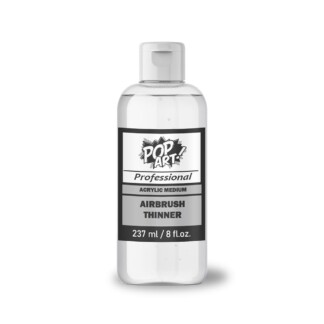
Airbrush thinner primarily reduces the viscosity of paint.
It is useful when acrylic paint is physically too thick to spray effectively through your airbrush.
Flow improver primarily modifies paint flow and surface tension.
It can be useful when paint has already been adjusted to a suitable consistency but still dries too quickly around the needle or does not flow as smoothly as desired.
Depending on your paint and airbrush setup, you may use thinner, flow improver or both.
When Should You Use Flow Improver?
Consider adding flow improver when:
- paint begins drying around the needle during spraying
- you are working with fine spray patterns
- you are applying gradual gradients
- transparent layers need smoother application
- longer airbrush sessions make paint behavior less consistent
- environmental conditions cause acrylic paint to dry quickly
- you want additional control over paint flow
Start with a small amount rather than automatically adding large quantities.
Can Flow Improver Help With Tip Dry?
Tip dry occurs when paint begins drying around the airbrush needle tip.
This is common with water-based acrylic paints and can interrupt the spray pattern.
Flow improver can help reduce tip dry in some painting conditions by changing the way the paint flows and behaves during spraying.
However, it does not eliminate tip dry completely.
Tip dry can also be influenced by:
- paint consistency
- air pressure
- nozzle size
- environmental temperature
- airflow
- spraying distance
- painting duration
- paint formulation
Regularly checking and cleaning the needle tip during longer painting sessions may still be necessary.
How Much Flow Improver Should You Use?
There is no single universal amount that works for every paint and airbrush setup.
Different paints, pigments, nozzle sizes and environmental conditions can require different adjustments.
Start with a small quantity of flow improver in your prepared paint mixture.
Mix thoroughly and test the spray pattern.
If additional flow improvement is needed, add a little more and test again.
Avoid adding excessive amounts simply because the paint is not spraying correctly. First check whether the paint also needs thinning or whether the airbrush requires cleaning.
How to Use Airbrush Flow Improver
Prepare your acrylic paint according to the requirements of your airbrush setup.
If the paint is too thick, first adjust its viscosity with a compatible airbrush thinner when necessary.
Then add a small amount of POP ART Airbrush Flow Improver.
Mix thoroughly.
Test the mixture on paper, card or a spare surface.
Observe:
- spray consistency
- paint flow
- atomization
- needle-tip buildup
- transparency
- control
Make small adjustments until the mixture behaves as required.
Flow Improver for Miniature Painting
Miniatures often require precise airbrush control.
Flow improver can be useful for:
- smooth base coats
- zenithal-style highlighting
- gradual shadows
- color transitions
- glow effects
- fine shading
- transparent layers
- controlled highlights
Because miniatures contain very small details, excessive paint buildup should be avoided.
Work gradually and build color with controlled passes.
Flow Improver for Scale Models
Aircraft, vehicles, armor, ships, Gunpla and other scale models often involve large smooth panels as well as fine surface details.
Airbrush flow improver can help support controlled spraying when creating:
- smooth base colors
- camouflage
- panel shading
- color modulation
- gradients
- weathering layers
- transparent effects
Always adjust the paint mixture according to the particular paint and airbrush being used.
Flow Improver for 3D Prints
Flow improver can also be used when airbrushing properly prepared 3D-printed figures, statues, props and decorative models.
Clean and prepare the printed surface before painting.
Use a suitable primer when required, then apply acrylic color using controlled airbrush layers.
Flow improver may be helpful when you need smoother paint behavior across printed details and complex surfaces.
Flow Improver for Fine Detail Airbrushing
Fine-detail spraying requires careful coordination between paint consistency, pressure, nozzle size and trigger control.
Flow improver can support fine-detail work by helping paint move more consistently through the airbrush.
Do not rely on a single fixed pressure setting for every project.
Instead, test your paint mixture and equipment combination until the spray pattern provides the control you need.
Flow Improver for Gradients and Shading
Smooth gradients are one of the major advantages of airbrush painting.
Gradually overlapping thin layers can create soft transitions between highlights, midtones and shadows.
Flow improver can help the paint behave more consistently during this type of controlled spraying.
Build the transition slowly instead of trying to create the entire gradient in a single heavy application.
Flow Improver for Glazes and Transparent Layers
Airbrush painters sometimes use highly transparent color layers to modify an existing paint job.
These layers can be useful for:
- tinting
- color correction
- shadows
- highlights
- glow effects
- tonal transitions
Flow improver can help support smooth application when working with these thin paint mixtures.
Because transparency increases as paint is reduced, test the mixture carefully before applying it to the final model.
Can Flow Improver Be Used With Metallic Paint?
Metallic and special-effect paints can behave differently from standard acrylic colors because of their pigment or particle characteristics.
Flow improver may help with paint behavior in some compatible metallic mixtures, but it does not guarantee that every metallic paint will spray effectively through every nozzle.
Always check the paint manufacturer’s recommendations and test the mixture first.
Larger particles may require a different nozzle or airbrush setup regardless of the additives used.
Flow Improver and Smaller Airbrush Nozzles
Smaller nozzles generally require greater attention to paint consistency and cleanliness.
If paint is too thick, flow improver alone may not solve the problem.
Use a compatible airbrush thinner when viscosity needs adjustment.
Flow improver can then be added when additional flow control or reduced premature drying is needed.
Keeping these two functions separate makes it easier to diagnose spray problems.
Why Is My Airbrush Still Clogging?
Flow improver cannot solve every cause of clogging.
If your airbrush continues to clog, check:
Paint Consistency
The paint may still be too thick for your nozzle.
Dried Paint
Acrylic paint can dry inside the nozzle or around the needle.
Paint Particles
Particles, dried paint or contamination may block small passages.
Airbrush Cleanliness
Residual paint from previous sessions can affect spray performance.
Equipment Condition
A damaged needle, nozzle or seal can also produce an inconsistent spray pattern.
Address the underlying cause rather than continually increasing the amount of flow improver.
Why Is My Airbrush Spitting?
Spitting or irregular spraying can have several causes, including:
- dried paint
- paint buildup
- unsuitable consistency
- contamination
- moisture
- nozzle problems
- equipment damage
- incorrect setup
Check and clean the airbrush first.
Then test paint consistency and flow.
If the paint is correctly thinned but still dries quickly or does not flow smoothly, a small amount of flow improver may help.
Flow Improver vs Water
Water can reduce the viscosity of water-based acrylic paint, but water and flow improver do not perform exactly the same function.
Flow improver is specifically used to modify flow and surface tension.
If the paint needs significant viscosity reduction, use an appropriate thinning method.
If the goal is primarily improved flow or reduced premature drying around the needle, flow improver may be more appropriate.
Can Flow Improver Be Used for Brush Painting?
Flow improver can also influence acrylic paint during brush application.
Reduced surface tension can help paint flow more smoothly across the surface, which may be useful for certain techniques.
However, POP ART Acrylic Thinning Medium is generally the more direct product when the primary goal is adjusting paint consistency for brush painting, layering or glazing.
Use Flow Improver primarily when flow behavior is the issue you want to modify.
Flow Improver for Masking and Clean Edges
Improved paint flow can be useful when airbrushing around masking tape, stencils and similar masking materials.
Smooth, controlled application helps reduce excessive paint buildup near masked edges.
Apply several light passes rather than flooding the area with paint.
Make sure masking materials are correctly applied before spraying.
Flow Improver Is Not Airbrush Cleaner
Flow improver should not be confused with airbrush cleaner.
Flow improver is mixed with paint during painting.
Airbrush cleaner is used to remove paint residue from the equipment.
After painting, flush and clean your airbrush according to its maintenance instructions.
Proper cleaning remains one of the most important ways to prevent future spray problems.
Tips for Better Airbrush Flow
For more consistent spraying:
- mix paint thoroughly
- adjust paint viscosity when necessary
- add flow improver gradually
- use a nozzle suitable for the paint
- test before painting your model
- keep the needle and nozzle clean
- avoid letting acrylic paint dry inside the airbrush
- clean the equipment after each painting session
Flow improver works best as part of a properly prepared airbrush system rather than as a substitute for correct setup.
250ml Bottle for Regular Airbrush Painting
The 250ml bottle provides a practical quantity for painters who regularly use flow improver with acrylic airbrush paints.
It is suitable for miniature painters, scale-model builders, 3D-print painters and hobbyists who use their airbrush frequently.
Use only the amount required for the desired effect.
Complete Your Airbrush Painting Setup
Pair POP ART Airbrush Flow Improver with compatible:
- airbrush paints
- model paints
- airbrush thinner
- acrylic thinning medium
- primers
- airbrush cleaner
- airbrushes and compressors
- acrylic varnishes
Each product performs a different role in the painting workflow.
Use thinner to adjust paint viscosity, flow improver to modify flow behavior, cleaner to maintain your airbrush, and varnish when final surface protection or finish adjustment is required.
Frequently Asked Questions
What is airbrush flow improver?
It is an additive used to modify the flow and surface tension of compatible water-based acrylic paint during airbrushing.
Is flow improver the same as thinner?
No. Thinner primarily reduces paint viscosity, while flow improver primarily modifies paint flow and working behavior.
Does flow improver prevent tip dry?
It can help reduce tip dry in some conditions, but it cannot completely prevent it. Paint formulation, pressure, nozzle size and environmental conditions also affect tip dry.
How much flow improver should I use?
Start with a small amount and increase gradually only when necessary. There is no universal ratio for every paint and airbrush setup.
Can I use flow improver with POP ART Airbrush Paint?
Yes, when additional flow adjustment is required.
Do ready-to-airbrush paints always need flow improver?
No. If the paint already sprays correctly, additional additives may not be necessary.
Can flow improver fix a clogged airbrush?
Not necessarily. A clog may require cleaning, additional thinning or equipment inspection.
Can it be used for brush painting?
It can modify paint flow during brush application, although an acrylic thinning medium may be more suitable when the main goal is general brush-paint consistency adjustment.
Shop Airbrush Flow Improver in Egypt
POP ART Airbrush Flow Improver 250ml is designed for hobbyists, miniature painters, scale-model builders and 3D-print painters who want greater control over water-based acrylic paint flow during airbrushing.
Use it in small amounts to modify paint flow, support smoother spraying and help reduce premature paint drying around the airbrush needle when needed.

 AR
AR  EN
EN 

المراجعات
There are no reviews yet